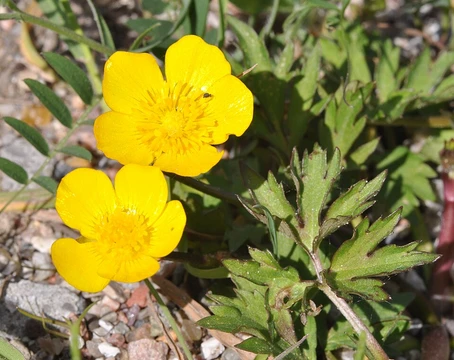
Asteraceae
A large family of flowering plants with composite flower heads.

Wikipedia / Wikimedia Commons
Asteraceae is a large family of flowering plants, first described in 1740 under the original name Compositae. It comprises over 32,000 known species in more than 1,900 genera within the order Asterales, rivaled in number only by Orchidaceae. The family is commonly known as the aster, daisy, composite, or sunflower family. Most species are herbaceous, but shrubs, vines, and trees also exist. They are found on every continent including Antarctica, in a wide variety of habitats, most commonly in hot desert and cold or hot semi-desert climates. Their primary distinguishing characteristic is the compound flower head, or capitulum, consisting of many tiny florets enclosed by involucral bracts.
- First described
- 1740
- Original name
- Compositae
- Number of known species
- over 32,000
- Number of genera
- over 1,900
- Order
- Asterales
- Oldest known fossils
- pollen grains from Late Cretaceous (Campanian to Maastrichtian) of Antarctica, c. 76–66 million years ago
- Estimated crown group evolution
- at least 85.9 million years ago (Late Cretaceous, Santonian)
Lore & Background
Members of Asteraceae are mostly herbaceous plants, but some shrubs, vines, and trees (such as Lachanodes arborea) exist. They are generally easy to distinguish by their unique inflorescence and joined anthers of the stamens, though determining genera and species of some groups, such as Hieracium, is notoriously difficult. The family produces taproots or fibrous root systems, and some species have underground stems in the form of caudices or rhizomes. Stems are herbaceous, aerial, branched, and cylindrical with glandular hairs, and may contain secretory canals with resin or latex, particularly common among the Cichorioideae. Leaves can be alternate, opposite, or whorled, simple or deeply lobed, and may also contain resin or latex.
Reader's Guide
Asteraceae is an economically important family, providing food staples, garden plants, and herbal medicines. Species outside their native ranges can become weedy or invasive. The family's distinctive capitulum—a dense head of many small florets surrounded by involucral bracts—attracts pollinators by visually presenting as a single flower. The previous name Compositae reflects this composite nature. The oldest known fossils are pollen grains from the Late Cretaceous of Antarctica, dated to c. 76–66 million years ago, with the crown group estimated to have evolved at least 85.9 million years ago. The family's widespread distribution and adaptability to diverse habitats, from subpolar to tropical regions, underscore its ecological and evolutionary significance. The pappus, a structure of threadlike or bristly hairs surrounding the ovary, aids in seed dispersal by adhering to animal fur or being carried by air currents.
Did You Know?
- The family was first described in 1740 under the original name Compositae.
- The oldest known fossils of Asteraceae are pollen grains from the Late Cretaceous of Antarctica, dated to c. 76–66 million years ago.
- The capitulum, or flower head, consists of sometimes hundreds of tiny individual florets enclosed by a whorl of protective involucral bracts.
- The pappus, a structure of threadlike or bristly hairs, aids in seed dispersal by adhering to animal fur or being carried by air currents.
Frequently Asked Questions
Who is Asteraceae?
Asteraceae is a massive family of flowering plants in the order Asterales, originally described in 1740 under the name Compositae. It ranks as one of the two largest flowering-plant families, with over 32,000 species spread across more than 1,900 genera.
What are Asteraceae's powers/role?
The family's signature trait is its composite flower heads, in which many tiny florets cluster together to mimic a single large bloom. This structure is what gives daisies, sunflowers, and asters their instantly recognizable look.
How does Asteraceae's story end?
The earliest known fossils of the family are pollen grains from the Late Cretaceous (Campanian to Maastrichtian) of Antarctica, dating to roughly 76–66 million years ago. The family is still thriving across every continent except Antarctica, so its story is very much ongoing.
Why is Asteraceae important?
With more than 32,000 species, Asteraceae is rivaled in sheer diversity only by Orchidaceae among flowering plants. They occupy an enormous spread of habitats—from hot deserts to cold semi-deserts—and include herbaceous species as well as shrubs, vines, and even trees.
What is Asteraceae's origin story?
The family was first formally described in 1740 and originally called Compositae, a name that reflected its composite flower structure. It has since been reclassified under the order Asterales and is now commonly known as the aster, daisy, composite, or sunflower family.
More in Flowering Plant Families 1-21
Spotted an error? Know more?
This is a living reference — every entry is fact-audited, and reader corrections feed straight into our audit queue. Suggest an edit · See this site's audit record